Table of Contents
What is ANPR?
ANPR is an acronym for ‘automatic number-plate recognition’ and it is revolutionizing how car parks are managed.
Optimize your parking management operations with software
Find out how Wayleadr’s parking management software can help you reduce costs and enhance your employee experience
ANPR works by using optical character recognition technology. It uses cameras and technology to read license registration plates and capture other vehicle data.
This data includes the vehicle’s plates, the date and time it passes the cameras, as well as information on which direction it is travelling in.
Of course, car parks are not its only use. However, parking is an area where this technology is reaching new heights and offering facility managers a chance to raise the efficiency of their lot.
Both office and residential car lots are now seeing the possible benefits of using ANPR as part of their car park management systems.
ANPR, LPR, ALPR: different names, same technology
If you’re researching this technology in the US, you’ll usually see it called LPR (license plate recognition) or ALPR (automatic license plate recognition). In the UK and Ireland, the standard term is ANPR (automatic number-plate recognition).
All three describe exactly the same thing: cameras combined with optical character recognition software that reads vehicle plates and turns them into data your parking systems can act on.
The same regional split applies to the facilities themselves — what UK operators call a car park, US operators call a parking lot or parking garage. Throughout this guide, ANPR and LPR are interchangeable.
Integrating ANPR
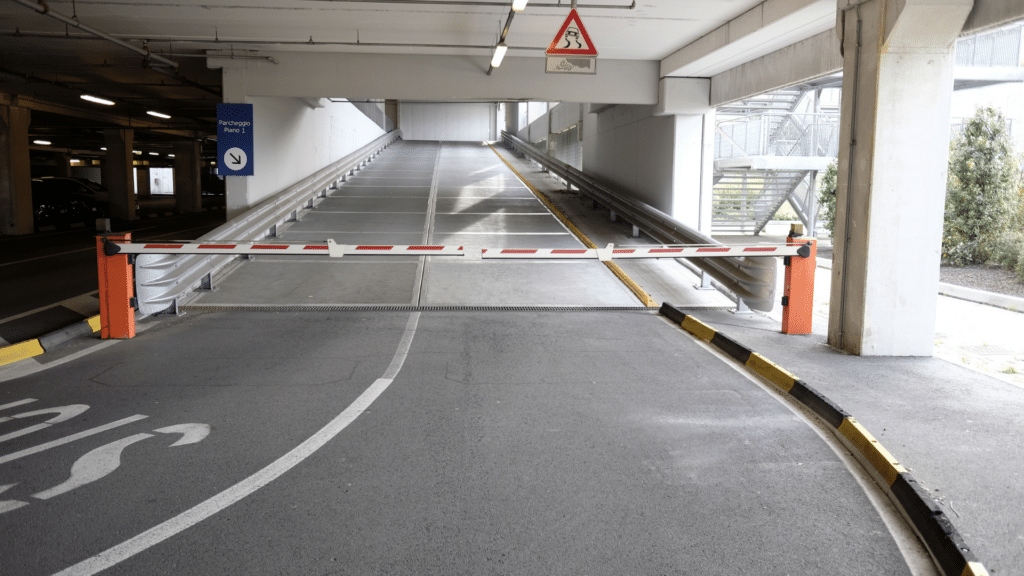
ANPR tech is usually placed at the entrance and exit points of car parks.
There, it can add an extra security measure to car park access control systems, such as barriers and gates. In an office car park environment, ANPR is particularly useful. Here it can be used to fully automate which vehicles have access and which don’t.
Wayleadr’s software can integrate ANPR with existing hardware to make lots safer and the management of these car parks hassle-free.
ANPR is convenient in terms of security, but it is also useful because we are sharing a lot with other businesses. It’s easier to break the lot and track occupancy.
License plate recognition for parking management: 5 ways to use it
Whether you call it LPR or ANPR, the value comes from connecting plate data to your parking management workflows. The most common integrations:
1. Touchless entry and exit. The license plate becomes the credential — no fobs, tickets, or apps needed at the barrier. Cameras read the plate and the gate opens for authorized vehicles.
2. Virtual permits. Instead of hangtags or stickers, the plate itself is the permit. Parking software checks each plate against the permitted list in real time, so permit management runs without any physical credentials.
3. Automated enforcement. Unregistered vehicles and overstays are flagged automatically, with notices triggered through your existing communication channels — no patrols or manual plate checks.
4. Visitor and guest parking. Pre-register a guest’s plate and they drive straight in. When the visit ends, access expires automatically.
5. Occupancy and utilization data. Every entry and exit is logged, giving facilities teams accurate occupancy data to plan allocation, pricing, and capacity decisions.
Because Wayleadr is hardware-agnostic, these workflows run on top of the LPR or ANPR cameras you already have — see how it fits together on our parking access control page.
Benefits of ANPR for office car parks
ANPR for car parks is also useful when it comes to the enforcement of rules.
If a car in your office lot is overstaying its permitted time, you can integrate your software to notify that employee.
Wayleadr’s easy-to-use app allows for this as it can integrate into your existing communications plan.
It is also an ideal tool for managing visitors, as you can add license plate numbers to the permitted vehicle list. You can then remove those plate numbers when that visitor no longer needs to use your facility.
ANPR can help you reduce your overall office facilities cost, as it removes the need for a manned security guard.
If needs be, it can also only allow entry to users at designated times or days. In a hybrid working world, this can be vital as it makes it easier to manage the parking needs of a flexible workforce.
ANPR has also helped businesses reduce their carbon footprint. It can do this by encouraging car sharing via only allowing staff vehicles entrance a certain number of days each month.
Despite that long list of advantages, the key benefit that businesses always cite is ‘improved user experience’. Quite simply, it makes employee parking easier.
Benefits of ANPR for residential car parks
One of the key advantages of ANPR is that it works 24 hours every day. In doing so, there is no need to have security staff on site.
It’s also reliable in all weather conditions and is useful for revenue generation. Notices can be sent to apartments where vehicles are registered.
It is also a great tool for crime prevention. All vehicles that come to and from the building are tracked.
From a safety point of view, it gives details of what vehicles have left the lot. In the unlikely case of an emergency, this information is vital.
Wayleadr’s residential platform integrates with existing parking systems to improve security, streamline communication, and automate guest access for multifamily buildings.
The technology already works to improve the lives of people working in some of the world’s best known businesses. It is now about to change people’s home lives too.
How much does an ANPR parking system cost?
There is no single price — an ANPR setup is quoted by the lane, not by the car park. The main cost drivers are:
- Lanes, and entry vs. exit — full in/out tracking needs a camera at each point, so two per lane.
- Gate hardware — the controller, barrier integration, and any new equipment at the entrance.
- The software layer — platform licensing and integration with your access-control or payment system.
- Installation — power and network at every camera point.
As a rough guide, a single-lane, entry-only setup typically starts in the low thousands, while a multi-lane site with entry and exit cameras and full software runs into the tens of thousands. The larger long-term cost is usually the software and support contract, not the cameras — which is why the management platform you pair the cameras with matters as much as the hardware itself.
Frequently Asked Questions
How much does it cost to install ANPR?
It depends on scale. A single-lane, entry-only ANPR setup generally starts in the low thousands; a multi-lane site with both entry and exit cameras plus software can reach the tens of thousands. The recurring software and support cost often outweighs the hardware over time.
How accurate is ANPR in car parks?
Modern ANPR systems achieve 95-99% read accuracy in well-lit conditions. Accuracy can drop in heavy rain, fog, or when plates are obscured. Pairing ANPR with a digital access control platform provides a fallback — if the camera misses a read, the driver can use their phone to open the barrier.
Can ANPR work with existing parking barriers?
Yes. ANPR cameras are typically added alongside existing barriers, not instead of them. The camera reads the plate, the software checks the permit list, and then signals the barrier to open — regardless of the barrier brand.
Is ANPR GDPR compliant for workplace parking?
It can be, with the right safeguards. License plates are personal data under GDPR, so you need a lawful basis for processing, a clear privacy notice for employees, and defined data retention periods.
Is LPR the same as ANPR?
Yes. LPR (license plate recognition, the US term) and ANPR (automatic number-plate recognition, the UK term) refer to the same camera-and-software technology. ALPR is a third variant of the same name. The capabilities are identical — only the regional terminology differs.
How does LPR parking enforcement work?
LPR cameras read each plate entering the facility and check it against the authorized list — permits, registered employees, or pre-approved guests. Unauthorized vehicles or overstays are flagged in real time, and enforcement actions like notifications or notices are triggered automatically by the parking management software.
ANPR is a tool that is here to stay and one that prepares car lots for the future of parking. It’s one of several car park entry system options available — but increasingly the preferred choice for enterprises that want zero-friction access. Learn how Wayleadr’s parking management software can integrate with existing ANPR systems by booking a demo.